The SKF Vibracon chock is a universal adjustable steel chock. Universal refers to the fact that a SKF Vibracon chock can be used instead of rigid steel chocks, shims or epoxy resin chocks. Adjustable refers to the possibility of aligning and re-adjusting the chock at every re-alignment event. The name of the chock "Vibracon" suggests that the elements can absorb vibrations like a vibration damper. We want to point out that the SKF Vibracon chock is absolutely not a vibration damper (resilient mount).
The design of the elements is based on products which are used to mount tool machines. In 1988 SKF Solution Factory - Marine Services designed the Original SKF Vibracon chocks. In 2003 SKF Solution Factory - Marine Services designed the low profile Vibracon® configuration.
In packaged units (like generator, compressor, turbine and pump sets) the benefits are:
On board ships for chocking propulsion units and auxiliary equipment:
In most of the applications the SKF Vibracon chocks will be cheaper because of:
Special skills or tools are not required to use SKF Vibracon chocks. SKF Solution Factory - Marine Services always advises
you to contact your local dealer or
SKF Solution Factory - Marine Services for support during the first
time installation of the elements. Also, check the installation procedure.
The use of laser alignment equipment is recommended but not necessary.
SKF Vibracon chocks are always on stock at SKF Solution Factory - Marine Services in the Netherlands and in the United States. However, it is recommended to check the delivery time before ordering. Our local dealers of the elements also have some elements on stock.
Please click here to find a distributor near you.
Yes, the primary forces for this Vibracon® sizing consideration are:
Fweight due to gravity
Ftorque due to the fact that the machine wants to rotate
Fbolt due to the tightening torque of the foundation bolt
Fbolt is approximately 6 till 10 times Fweight and even 10 till 15 times Ftorque.
This means that Fbolt is the critical force on the Vibracon® element.
If we consider for example the SKF Vibracon 30 chock, we can see that we are tightening a M30 bolt
against a M95 thread (internal thread size of a Vibracon® SM30). It is easy to understand that
the SKF Vibracon chock can’t be damaged by the machine forces unless the element sizes are
wrongly calculated or the foundation bolts are insufficiently tightened.
No, the chocks are only meant for chocking! For aligning the machine, hydraulic tools or jack bolts are recommended. When the weight of the machine is compressing the element it will lock itself automatically due to friction in the thread.
The SKF Vibracon chock will lock itself (due to friction in the thread) after the foundation bolts are tightened. It is not necessary to lock the chock in any other way.
Yes, there are limits to the standard chocks. Please check the SKF Vibracon data table for the minimum and maximum height of each type of chock. When designing a chocking arrangement, please have a look at the nominal height of the chock.
In this case, it is possible to use an additional bottom ring with an extended height (contact SKF Solution Factory - Marine Services or your local dealer). The maximum height of the chock should not exceed the diameter of the chock.
It is allowed to reduce the SKF Vibracon Original to a minimum reduced height which is mentioned in chapter 6 figure 6.4.2 Reducing the height can be done on a lathe by machining the centre and bottom part of the chock. Keep in mind that the adjustment capabilities also will be reduced. At the minimum reduced height, you will only have 1 mm adjustment capability left!
To do so you always need approval from SKF Solution Factory - Marine Services and the classification society. With permission it is possible to enlarge the bolt hole of the elements in accordance with the following table:
| Original Type | Low Profile Type | Bolt | Enlarged bolt hole (mm) |
| SM12 | M16 | 17 | |
| SM16 | SM16LP | M20 | 21 |
| SM20 | SM20LP | M24 | 25 |
| SM24 | SM24LP | M30 | 31 |
| SM30 | SM30LP | M36 | 37 |
| SM36 | SM36LP | M42 | 43 |
| SM42 | SM42LP | M48 | 49 |
| SM48 | M56 | 57 | |
| SM56 | M64 | 65 | |
| SM64 | M72 | 73 |
Please contact your local dealer or SKF Solution Factory - Marine Services to calculate the bolt torque and recommended clamped length.
In general, it is not necessary to ream through the SKF Vibracon chock. Reaming only the foot of the machine and the foundation usually will do. In some situations (for example in cases where no side and collision stoppers are installed) we also advise to ream the SKF Vibracon chocks. Please contact your local dealer or SKF Solution Factory - Marine Services for additional information on this matter.
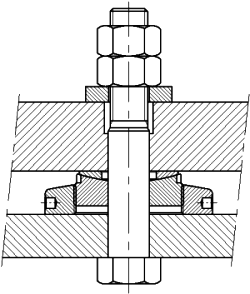
Figure 5.2.8 General arrangement for a fitted bolt
After the alignment and the securing of the foundation bolts, weld down a block of steel (which is just 1 mm lower than the chocks) near at least one of SKF Vibracon chocks or between two chocks. Drill a hole through the foot of the machine into this block. Now the dowel pin can be installed.
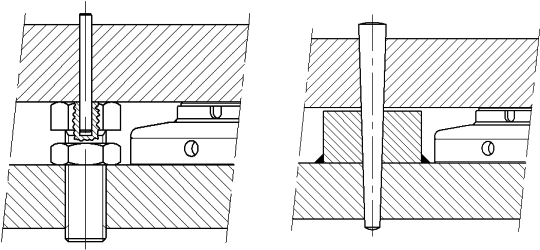
Figure 5.2.9 Alternatives for a dowel pin application
Yes, The SKF Vibracon Original and SKF Vibracon Low Profile chocks are approved by all major shipbuilding classification societies and a large number of original equipment manufacturers, as well as the U.S. Navy.
However, it is always necessary to submit a calculation and a sketch of the chocking arrangement
for approval for each application. This is mainly necessary for propulsion units and for some
societies, also for auxiliary equipment.
Contact your local dealer or SKF Solution Factory - Marine Services for assistance.
For the production of a, free of charge, SKF Vibracon chocking proposal it is necessary to fill in a datasheet, which you can download by following this link.
The following data is requested:
Additional information when it concerns a gearbox:
SKF Solution Factory - Marine Services has developed bolt torque calculation software in close cooperation with original equipment manufacturers and classification societies. The philosophy of the calculating software is to reach a minimum bolt elongation (stretch) of 0.20 mm in the bolted connection. The bolts are to be tightened within the elastic range of the bolt material, in general SKF Solution Factory - Marine Services advices a maximum bolt tension related to 75% of the yield strength of the bolt material.
The values stated in our SKF Vibracon brochure are based on the above mentioned calculations rules. The mentioned values are valid for bolts with course thread, material grade 8.8, yield strength > 630 N/mm², oil lubricated thread courses and nut mating surfaces without slide additives.
As a service to our customers, SKF Solution Factory - Marine Services offers you a chocking proposal, with the advised tightening torque included, for your application free of charge!